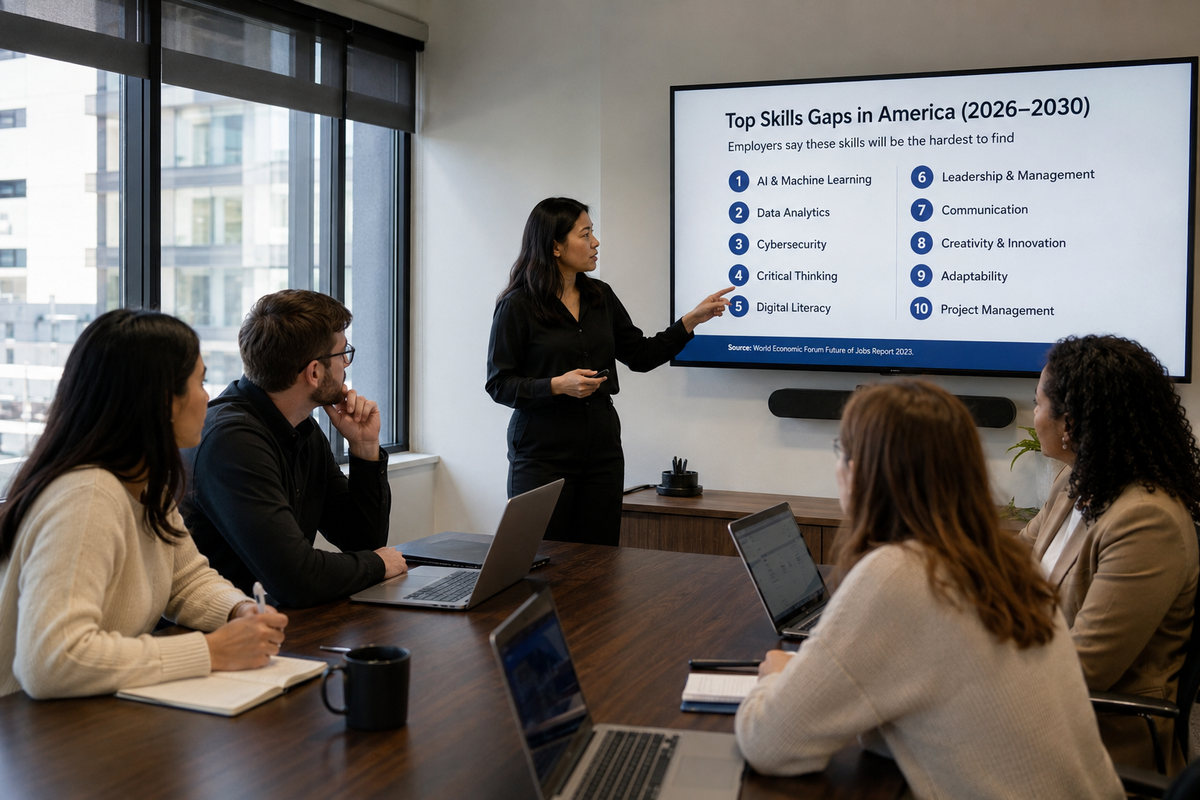
Top Skills Gaps in America (2026-2030)
The next five years may represent one of the most consequential workforce transitions in modern history. Artificial intelligence (AI), automation, demographic shifts, and technological transformation are converging to create unprecedented levels of labor market disruption.

Take Home Points
• The next five years will bring unprecedented workforce disruption as artificial intelligence, automation, and demographic shifts reshape jobs and required competencies.
• The greatest challenge may not be unemployment alone, but employability, as millions of workers will need re-skilling and upskilling to remain relevant in a rapidly changing labor market.
• Workers who combine AI literacy with uniquely human skills such as critical thinking, creativity, adaptability, and emotional intelligence are likely to be more resilient and competitive.
• Employers, governments, and educational institutions will need to expand access to continuous training and lifelong learning to reduce workforce displacement and inequality.
Introduction
In the next five years, the biggest workforce storm is likely to hit the United States and the rest of the world. The process will necessitate massive re-skilling and de-skilling mainly because of AI automation, local transformation, and demographic change. Top issues to look out for include:
1. Extinction of outdated job skills: As many as 39% of existing job skills will become outdated by 2030[1]. This is a mix of job roles that will not be needed anymore and job roles. Put together, approximately two out of five job roles will be eliminated in the next five years.
2. Occupational switching: Between 2020 and 2025, an estimated 17% of US workers have switched occupations[2] because of AI and related changes to the job market. This is a historic high.
3. The need for new skills: Some projections assert that 59% of workers will require retraining by 2030[3] because meaningful skill upgrades and career pivots will not be optional, but essential for survival in the workforce. Deskilling will be more pronounced in repetitive, rules-based roles or highly automatable works.
4. More employers will prioritize upskilling: As many as 85% of employers will encourage upskilling[4] which involves learning new competencies altogether to be able to maintain a fast-changing work cycle.
5. Employers will hire workers with new skill profiles: Estimates indicate that 70% of employers will hire workers with new skill profiles[5] that are not known, therefore, making the workforce more competitive.
6. Reduction in staff: A trend of de-skilling is projected as approximately 40% of employers are expected to reduce staff when skills become irrelevant[6], thereby shrinking job opportunities.
7. Generative AI is already in use in many job roles: Some 20% of workers in America admit they use GenAI regularly to complete their tasks and projects[7]. As such AI literacy is fast becoming a baseline competency.
8. Urgent reskilling required by 2028: An estimated 29% of employees will require reskilling in the next two years to stay relevant in their job roles[8]. Reskilling will be predominant in areas that mix technical and human abilities, including AI literacy, data analytics, cybersecurity, and automation management.
9. Upskilling required for by 2028: As many as 53% of job roles will need upskilling in the next two years[9], thereby requiring some changes in the years ahead.
10. Weak training access will lead to some job displacement: Those who do not get adequate training are likely to become displaced in the workforce entirely.
Why the Next Five Years Will Be Different
Unlike previous industrial revolutions, the coming transformation is not only about machines replacing physical labor. It is increasingly about intelligent systems reshaping cognitive work itself. Earlier waves of automation displaced primarily manual or repetitive industrial activities, forcing workers into service-oriented sectors. However, generative artificial intelligence, robotics, predictive analytics, and automation technologies are now affecting occupations that once appeared secure, including legal research, administration, customer service, accounting, logistics, software development, journalism, education, and even some healthcare functions.
Many occupations will survive, but the skills required to perform them will shift dramatically. A marketing professional, for example, may still remain in marketing, but future competitiveness will likely require competence in AI-assisted content creation, predictive customer analytics, automation tools, and digital strategy. Similarly, teachers may increasingly rely on adaptive AI systems to personalize learning, while healthcare workers may need competencies in AI-supported diagnostics and electronic decision-support systems.
Consequently, the challenge of unemployment will be replaced with the question of employability. Workers who fail to adapt risk exclusion not necessarily because their profession disappears entirely, but because their existing competencies become obsolete.
The Way Forward
The next five years may represent one of the most consequential workforce transitions in modern history. Artificial intelligence, automation, demographic shifts, and technological transformation are converging to create unprecedented levels of labor market disruption. Millions of workers may experience some form of de-skilling, occupational transition, or job displacement, while employers increasingly seek entirely new skill profiles.
Yet this transformation should not be viewed solely through the lens of crisis. It also presents an extraordinary opportunity. Entirely new industries, occupations, and pathways for economic mobility are likely to emerge. Workers who proactively embrace re-skilling and adaptability may find themselves better positioned than ever before.
The defining challenge of this era will not simply be whether jobs disappear, but whether societies, institutions, employers, and individuals move quickly enough to prepare for what comes next. In the age of intelligent automation, survival in the workforce may increasingly depend not on what people already know, but on how quickly they can learn, unlearn, and learn again.
[1] World Economic Forum. "The Future of Jobs Report 2025" January 7, 2025. Retrieved: <https://www.weforum.org/publications/the-future-of-jobs-report-2025/digest.com>
[2] McKinsey & Company. "The upskilling imperative: Required at scale for the future of work". May 13, 2025. Retrieved: <https://www.mckinsey.com/industries/public-sector/our-insights/the-upskilling-imperative-required-at-scale-for-the-future-of-work>
[3] KPMG. "Future-proof your workforce by 2030". 2025. Retrieved: <https://kpmg.com/us/en/articles/2025/future-proof-workforce-2030.html>
[4] World Economic Forum. "The Future of Jobs Report 2025" January 7, 2025. Retrieved: <https://www.weforum.org/publications/the-future-of-jobs-report-2025/digest.com>
[5] Ibid
[6] Ibid
[7] McKinsey & Company. "The upskilling imperative: Required at scale for the future of work". May 13, 2025. Retrieved: https://www.mckinsey.com/industries/public-sector/our-insights/the-upskilling-imperative-required-at-scale-for-the-future-of-work
[8] Craig Hale. ""'2026 is the year CEOs must rewire the C-suite': IBM study reveals what successful leaders are actually doing with AI work in their businesses" Tech Radar. May 8, 2026. Retrieved: <https://www.techradar.com/pro/2026-is-the-year-ceos-must-rewire-the-c-suite-ibm-study-reveals-what-successful-leaders-are-actually-doing-with-ai-work-in-their-businesses>
[9] Ibid